 +886-2-8227-8923

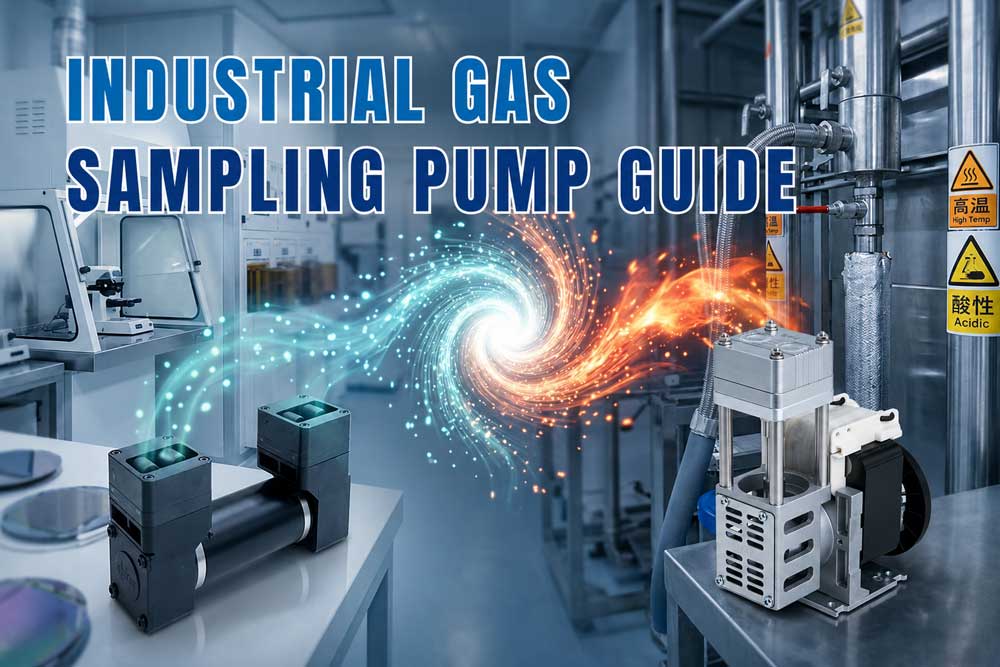
From high-temperature stack gas to corrosive chemical process streams and compact OEM analyzers — every application demands different things from an air sampling pump. This guide gives you the engineering framework to make the right choice and avoid the silent failures that derail monitoring systems in the field.
What Is an Air Sampling Pump — and Why Industrial Applications Demand More Than a Standard Model
An air sampling pump is a device that draws a controlled volume of gas from a target environment and delivers it, unaltered, to a measurement or analysis system. Unlike a vacuum pump — which exists purely to generate pressure differential — an air sampling pump has an additional obligation: to preserve the composition of whatever it’s moving. That distinction drives everything about how it’s built.
In a laboratory or cleanroom, this is relatively straightforward. The gas is at ambient temperature, chemically mild, and free of particulates. A standard diaphragm pump handles the task without difficulty. In an industrial air sampling context, the conditions change dramatically. Stack gas may be at 200 °C. Chemical plant vents carry acid vapors. Semiconductor fab exhaust combines hydrofluoric acid, ammonia, and organic solvents in the same stream. Battery manufacturing lines release high-boiling solvents that condense at room temperature. Each of these scenarios can destroy a pump that wasn’t specified for the application — and none of them will announce the failure loudly. Instead, they produce slowly drifting data, unexplained measurement offsets, and abbreviated service life.
⚠ The Silent Failure ProblemMost industrial sampling pump failures are gradual. A diaphragm stiffened by acid gas exposure. A valve seat losing its seal over hundreds of hours. A partial condensate blockage accumulating in the transport line. None of these trigger a system alarm — they appear as measurement drift or data offsets, invisible until a maintenance inspection finds the cause. Getting the specification right upfront costs far less than diagnosing the downstream effects of a mismatch.
Understanding what an industrial air sampling pump needs to do — and the specific conditions under which it will operate — is the starting point for every successful installation. The sections below walk through the criteria, the failure modes, and the selection logic that engineers use in practice.
What Makes the Best Industrial Air Sampling Pump? Five Criteria That Actually Matter
The question of which is the best air sampling pump for industrial use has no single answer — it depends entirely on the gas being sampled, the installation environment, and the role the pump plays in the measurement system. What the question does have is a reliable set of evaluation criteria. Here are the five that separate pumps that perform from ones that just look good on paper.
1. Media Temperature Rating
This is the single most important specification for industrial applications, and the one most commonly overlooked. Media temperature is the temperature of the gas being pumped — not the ambient air around the pump. A standard diaphragm pump rated to 40 °C media cannot safely handle a 180 °C flue gas stream, regardless of how it’s positioned in the system. Exceeding the media temperature limit accelerates diaphragm hardening and cracking, and the failure develops gradually over weeks — making it easy to misread as analyzer drift.
2. Wetted Material Compatibility
Every component the gas contacts — pump head, diaphragm, valve seats, gaskets — must be chemically compatible with the full gas mixture, not just the dominant species. A standard EPDM diaphragm performs well in clean air and mild VOC service, but degrades progressively under sustained exposure to acid gases such as SO₂, HCl, or HF. For corrosive service, a typical material configuration includes a stainless steel pump head with PTFE diaphragm and valves, combined with FKM or FFKM gaskets depending on sealing requirements and chemical severity. PTFE provides excellent chemical resistance but, due to its low elasticity, sealing performance depends on system design; FKM offers a balance of chemical resistance and reliable sealing; FFKM is used in applications requiring both extreme chemical resistance and high sealing stability. This approach covers the majority of industrial acid gas monitoring scenarios.
3. Flow and Vacuum Performance Against Real System Resistance
Rated flow is always measured at zero back pressure. In a real installation — with transport tubing, filter housings, moisture separators, and sample conditioners — the actual delivered flow can be significantly lower. Size the pump against the full system pressure drop at worst-case operating conditions: a filter near the end of its service interval, not a clean system at first startup.
4. Power Supply and Installation Context
24 V DC suits OEM instruments, portable analyzers, and control-panel integrations. AC 115/230 V suits fixed industrial installations with plant utility power. Beyond power supply, the installation context — enclosure space, vibration level, ambient temperature range — determines form factor constraints that can be just as limiting as the electrical specification.
5. Controllability and Long-Term Maintainability
For continuous monitoring applications, pump speed control (PWM or voltage-based) allows flow to be matched precisely to analyzer requirements and extended over the pump’s usable life range. For maintenance, the key questions are: how quickly can the diaphragm and valve kit be replaced, and are spare parts readily available as a service kit? A pump that requires specialist tools or long lead times for consumables is a hidden operational cost in any continuous monitoring installation.
✅ Quick Fit SummaryIf your application is ambient-temperature gas, VOC monitoring, or OEM instrument integration at 24 V DC → the UN-15PV-BL addresses criteria 3–5 with its dual-head parallel/series configuration, 20 W draw, and PWM speed control. If your application involves high-temperature gas, acid or corrosive species, or direct process-side extraction → the UN-6PV-H’s 240 °C media rating and SS/PTFE/FFKM material stack addresses criteria 1–2 directly.
High-Temperature and Corrosive Gas Applications: The Toughest Test for Any Air Sampling Pump
Stack gas monitoring, chemical plant vent sampling, and semiconductor fab exhaust measurement represent the most demanding environments for any industrial air sampling pump. Temperatures above 150–200 °C, acidic combustion byproducts (SO₂, NOx, HCl), and saturated moisture content routinely appear together. Any one of these factors is capable of ending the service life of a pump that wasn’t built for the application. The three failure modes below are responsible for most pump replacements and data quality incidents in real-world high-temperature monitoring installations.
1. Condensate Blockage From Cooling the Sample Before the Pump
A pump rated to 40 °C media requires a cooling section before its inlet when used on hot gas streams. As the gas cools, water vapor and condensable organics drop out of the gas phase and accumulate in the transport line — causing partial blockages, filter overload, and systematic underreporting of heavier gas-phase components. In SO₂ or NOx streams, the condensate also forms acidic liquid that attacks downstream components far more aggressively than the original gas phase. The UN-6PV-H eliminates this problem: its 240 °C media rating allows extraction directly at the source, before condensation occurs.
2. Diaphragm and Valve Degradation From Acid Gas Exposure
EPDM and NBR degrade progressively under sustained acid gas contact. The failure mode is not sudden — it is a slow increase in flow resistance over weeks as the diaphragm stiffens and micro-cracks, and as valve seats lose their sealing geometry. This is consistently misread as filter fouling or analyzer drift until the pump is opened and the damage is visible. In acid gas service, the correct specification is PTFE diaphragm, PTFE valve seats, and FFKM gaskets — materials that remain chemically inert across the full range of industrial acid gas species.
3. Insufficient Vacuum for Long Transport Lines
Stack monitoring installations frequently require 5–15 meters of transport line between the extraction point and the analyzer enclosure. Each component in the sample path — tubing, fittings, filter housings, moisture separators — adds pressure drop that reduces delivered flow. Engineers who size a pump from its rated free-flow specification without accounting for real system resistance often find it operating at its vacuum limit in normal service. Any additional fouling then causes flow to collapse below the analyzer’s minimum requirement — at the worst possible time.
🔵 UN-6SPC-H: Built for This EnvironmentMedia temperature 5–240 °C · Stainless steel pump head · PTFE diaphragm and valves · FFKM gaskets · Max pressure 1.5 bar · AC 115/230 V. The combination of high media temperature rating and chemical-grade wetted materials addresses the three failure modes above from the ground up — allowing direct extraction at the process side without pre-cooling, resisting acid gas attack across SO₂, NOx, HCl, and HF service, and providing the pressure capability to handle high-resistance transport line configurations.
OEM Gas Analyzers and VOC Monitoring: When Low Power and Compact Size Win
Not every air sampling application involves extreme temperatures or corrosive gases. For portable VOC monitoring equipment, ambient air quality instruments, and OEM gas analyzer integration, the engineering priorities shift entirely. Here, the pump’s power draw, acoustic noise profile, physical form factor, and flow controllability matter far more than chemical resistance or temperature rating.
Consider what a 50 W difference in pump power consumption means inside a portable instrument. It’s not just the operating cost — it’s the heatsink size, battery capacity, charge cycle time, and thermal management design that all scale with that number. A design decision made at the pump selection stage locks in weight, cost, and engineering complexity across the entire product platform. Getting the pump right early is a leverage point that pays dividends through the full product lifecycle.
One Model, Two Configurations: The Dual-Head Advantage
OEM instrument manufacturers face a recurring challenge: the same sampling module platform must accommodate customers with different flow and vacuum requirements. Multiple pump SKUs increase BOM complexity and create qualification overhead for every product variant. The UN-15PV-BL solves this with its dual-head design:
| 🔶 Parallel Configuration Maximum flow: 15.5 LPM Maximum vacuum: 25 inHg Best for: higher flow demand, multi-point sampling One SKU covers both variants | 🔷 Series Configuration Maximum flow: 7.6 LPM Maximum vacuum: 29 inHg Best for: longer transport lines, higher system resistance No pump model change required |
Both configurations run at 20 W on a 24 V DC supply, with PWM or voltage-based speed control for precise flow adjustment between standby and active sampling states. At 166 × 46 × 82 mm and 1.9 kg, the UN-15PV-BL is sized for instrument enclosure integration — not an external accessory bolted on afterward.
✅ Design Note for OEM EngineersPWM-controlled speed adjustment allows flow to be dynamically matched to analyzer requirements and reduces pump mechanical load during standby periods — extending diaphragm life and reducing acoustic noise in low-demand states. For battery-powered portable instruments, the combination of 20 W draw and adjustable speed is a meaningful differentiator in thermal and power budget planning.
Chemical Resistant Pump Materials Explained: What PTFE, FFKM, Stainless Steel, and EPDM Actually Mean for Your Application
The term “chemical resistant pump” appears frequently in product descriptions, but the practical meaning depends entirely on which materials are used and for which gas species. Not all chemical resistance is equivalent — a pump that handles mild VOCs reliably may fail rapidly in acid gas service. Understanding the material options and their actual application limits removes the guesswork from specification.
| Material | Common Application | Acid Gas (SO₂/HCl/HF) | Organic Solvents (VOC) | High Temperature |
| EPDM | Mild VOC, clean air | Not suitable | Good (mild) | Limited (≤ 40 °C media) |
| PTFE | Acid gas, corrosive streams | Excellent | Excellent | Good (to ~260 °C) |
| FFKM | Extreme chemical / high temp | Excellent | Excellent | Excellent (to ~300 °C) |
| Stainless Steel (316L) | Pump head, general acid gas | Good (most species) | Good | Excellent |
| PPS (Polyphenylene Sulfide) | Mild corrosive, OEM | Moderate resistance | Good | Moderate |
The practical rule for specifying a chemical resistant air sampling pump in industrial service: if the gas contains any acid species (SO₂, NOx, HCl, HF), organic acids, or a mixture of corrosive components, a common configuration for corrosive gas applications is a PTFE diaphragm with FKM or FFKM gaskets and a stainless steel pump head, depending on sealing requirements and chemical severity. This is the material stack used in the UN-6PV-H, and it covers essentially all industrial acid gas monitoring scenarios.
For ambient-temperature VOC sampling, clean air monitoring, and applications without corrosive species, a PPS pump head with EPDM diaphragm and valves — as used in the DC-15SPC-BL — provides reliable service at lower system cost and with a smaller, lighter package suited to instrument integration.
⚠ Multi-Component Gas StreamsValidate material compatibility against the full gas mixture — not each species in isolation. HF in combination with moisture attacks EPDM faster than either does alone. SO₂ with condensed water forms sulfurous acid that is more corrosive than dry SO₂ gas. When in doubt, specify the higher-grade material configuration — the cost difference between EPDM and PTFE/FFKM service kits is small compared to the cost of an unplanned pump failure in a continuous monitoring installation.
Application Matrix: Which Air Sampling Pump Fits Your Industrial Scenario
| Application | Gas Conditions | Recommended | Key Reason |
| CEMS / Stack Gas Monitoring | High temp, SO₂/NOx, wet | UN-6SPC-H | 240 °C media rating; SS/PTFE/FFKM chemical resistance |
| Semiconductor Fab — upstream of abatement | Acid/alkali/VOC mix, elevated temp | UN-6SPC-H | Multi-species chemical resistance; handles high temp directly |
| Semiconductor Fab — analyzer module side | Post-scrubber, ambient temp | DC-15SPC-BL | 24 V DC; PWM control; compact for panel integration |
| Portable / Panel VOC Analyzer (OEM) | Ambient temp, mild VOC | DC-15SPC-BL | 20 W; dual-head flexibility; low acoustic noise |
| Chemical Process Vent Monitoring | Corrosive, wet, potentially hot | UN-6SPC-H | Direct process-side extraction; chemical-grade materials |
| Battery Mfg — NMP extraction point | High-boiling VOC, elevated temp | UN-6SPC-H | Prevents NMP condensation in transport line |
| Battery Mfg — analyzer interface | Conditioned sample, ambient temp | DC-15SPC-BL | Precise, adjustable flow for measurement accuracy |
| Air Quality / Environmental Monitoring | Ambient, clean, controlled flow | DC-15SPC-BL | Low power, quiet, speed-controllable for field deployment |
| Laboratory / Calibration Systems | Clean, ambient, precise flow | DC-15SPC-BL | PWM control; low vibration; OEM-friendly footprint |
Five Field Conditions to Confirm Before Selecting Any Industrial Air Sampling Pump
Whether you’re specifying a pump for a new CEMS installation, replacing an underperforming unit, or designing an OEM gas analyzer, the selection process should always begin with field condition documentation — not datasheet comparison. These five parameters determine model selection more decisively than any single rated specification.
- 📋 Pre-Selection Field Conditions Checklist
- 1. What is the gas temperature at the pump inlet?
- Above 40 °C requires a high-temperature pump. The UN-6PV-H handles media up to 240 °C. Connecting hot gas to a standard-temperature pump is the leading cause of premature diaphragm failure in monitoring installations — and it develops slowly, without obvious warning.
- 2. Does the gas contain corrosive or chemically active species?
- List every component in the gas stream. Acid gases (SO₂, HCl, HF), alkalis (NH₃), and many organic solvents each have specific material compatibility requirements. Verify the pump’s complete wetted material set — not just the diaphragm — against the full mixture.
- 3. Is the gas wet, or does it carry condensable vapors?
- Unmanaged moisture and condensable organics in the transport line are the most common source of sampling system blockage and composition error. Determine whether heated lines, a moisture trap, or a pre-filter are required — and factor these pressure drops into the pump’s vacuum specification.
- 4. What is the total transport line length and system pressure drop?
- Calculate resistance across the full sample path: tubing, fittings, filter elements, and sample conditioners. Size the pump to deliver required analyzer flow at worst-case resistance — a partially fouled filter, not a clean system at commissioning. Apply a 1.5–2× safety margin.
- 5. What is the power supply and installation context?
- 24 V DC for OEM instruments, portable equipment, and control panel installations. AC 115/230 V for fixed industrial sites with plant utility power. Installation space, vibration environment, and ambient temperature range further constrain form factor and drive requirements.
🔵 Tip for RFQ SubmissionsProviding all five conditions in your initial inquiry enables a supplier to return a material compatibility assessment, a flow and vacuum performance check against your system resistance, and a recommended maintenance interval — in one exchange rather than across multiple rounds of clarification.
FAQ: What Engineers and Buyers Ask About Industrial Air Sampling Pumps
The questions below cover the fundamentals, the selection logic, and the chemical resistance details that come up most in real engineering and procurement conversations.
Q1:What is air sampling, and why is the pump the most critical part of the system?
Air sampling is the process of drawing a gas from a target environment — a stack, process vessel, or open atmosphere — and delivering it unaltered to an analyzer. The pump is critical because it’s the first contact point: contamination, condensation, or material-induced composition changes at the pump invalidate every measurement downstream, regardless of analyzer accuracy.
Q2:What is an air sampling pump used for in industrial environments?
Industrial air sampling pumps are used in: CEMS (drawing flue gas from stacks to SO₂/NOx analyzers); process gas monitoring (sampling reactors or pipelines for quality control); workplace VOC monitoring (measuring solvent vapor exposure); environmental monitoring (ambient air at site perimeters); and OEM instrument integration (as the internal sampling mechanism inside portable analyzers). In every role, the objective is the same — deliver the gas to the analyzer exactly as it was found at the source.
Q3:What are the best air sampling pumps for industrial use – and what should I look for?
The best industrial air sampling pump is the one correctly matched to your application conditions — not simply the highest-rated or lowest-cost option.
Key selection criteria include:
– Oil-free diaphragm design to prevent contamination
– Correct media temperature rating (e.g., up to 240 °C for hot gas or 40 °C for ambient conditions)
– Chemically compatible wetted materials (such as PTFE, FKM, or FFKM with stainless steel), selected based on gas composition, sealing requirements, and system design
– PWM speed control for precise flow regulation
– Availability of service kits for preventive maintenance
Each material offers different trade-offs: PTFE provides excellent chemical resistance but requires proper sealing design due to its low elasticity; FKM balances chemical resistance and sealing performance for most industrial gases; FFKM is used in applications requiring extreme chemical resistance and high sealing stability.
When these factors are correctly matched, the “best” pump becomes the most reliable and cost-effective solution for your specific process.
Q4:What makes a pump “chemical resistant”–and does it actually matter for gas sampling?
“Chemical resistant” means every wetted surface inside the pump — diaphragm, valves, gaskets, pump head — is inert to the gas being sampled. It matters critically: standard EPDM elastomers degrade slowly under acid gas contact (SO₂, HCl, HF), showing up as gradual flow loss mistaken for filter fouling. A genuinely chemical resistant pump for corrosive service — like the UN-6PV-H — uses PTFE diaphragm and valves, FFKM gaskets, and a 316L stainless steel pump head. This stack remains stable across long service intervals in mixed acid gas streams.
Q5:Can I use one air sampling pump for both high-temperature stack gas and ambient
VOC monitoring?
Generally no — and media temperature rating is why. A 240 °C-rated pump like the UN-6PV-H can physically handle ambient gas, but its 70 W / AC power profile makes it impractical inside a portable VOC instrument. Conversely, connecting a 40 °C-rated pump like the UN-15PV-BL to hot stack gas causes progressive diaphragm failure. For installations that need both — such as semiconductor fab monitoring with a hot extraction point and ambient-temperature analyzer integration — the correct approach is one pump per role. Each does what it was designed for; the system as a whole is more reliable for it.
Q6:How often should an industrial air sampling pump be serviced, and what are the signs it needs attention?
Typical service interval: 12 months in standard service, 6 months in corrosive or high-temperature conditions. The wearing parts are the diaphragm, valve plates, and gaskets — replace these as a kit on schedule rather than waiting for failure. Early warning signs: gradual flow decline not explained by filter loading, increased vibration or noise, or slowly drifting analyzer readings. Two practices extend intervals most: a particle pre-filter upstream of the pump, and a moisture trap where the gas is wet.
Q7:How do different materials affect the lifespan and stability of air sampling pumps?
EPDM: Suitable for moisture and general gases. It is cost-effective but not recommended for long-term exposure to solvents or oil vapors.
FKM: Suitable for acidic gases and most organic solvents, offering a good balance between chemical resistance and sealing performance.
PTFE: Provides the highest level of chemical resistance, but due to its low elasticity, sealing performance depends on system design.
FFKM: Combines near-universal chemical resistance with excellent sealing performance, making it suitable for high-end analytical applications and extremely demanding environments.
Find the Right Air Sampling Pump for Your Application
Tell us your media temperature, gas composition, and installation context — and we’ll confirm the correct model, material configuration, and expected service interval for your specific conditions.