 +886-2-8227-8923

Transportation
Material handling and conveying are essential functions across modern manufacturing, warehousing, and logistics operations. This discipline covers the movement, storage, protection, and control of raw materials, components, and finished products throughout processes such as incoming material receipt, internal production flow, inventory management, and outbound distribution. From traditional manual forklifts and hand labor to today’s advanced automated conveyor systems and intelligent logistics solutions, businesses demand higher efficiency in material flow to boost productivity and competitiveness. Automated material handling significantly enhances production output, reduces labor costs, improves safety, and optimizes inventory movement while minimizing material damage and process bottlenecks. Advanced logistics systems integrate sensors, controllers, robotic arms, automated guided vehicles (AGVs/AMRs), and smart software platforms to achieve end-to-end automation and real-time visibility, improving overall equipment effectiveness (OEE) and operational transparency. Material handling goes beyond simple transportation; it incorporates scheduling, warehouse management, and intelligent sorting, enabling companies to respond flexibly to market changes and diverse demands. With ongoing developments in Industry 4.0, smart manufacturing, and e-commerce logistics, material handling systems are evolving toward modular design, system integration, and data-driven intelligent decision-making. Vacuum conveying, pneumatic conveying, mechanical conveyors, and automated sorting equipment provide efficient, low-contamination, and low-maintenance material flow solutions across industries such as electronics, food, pharmaceuticals, and chemicals, helping enterprises achieve safe, precise, and energy-efficient supply chain operations.
Vacuum Pick-and-Place / Material Transfer System
Vacuum pick-and-place systems use vacuum pumps to create negative pressure, allowing suction cups or vacuum grippers to securely lift and relocate objects without direct contact. Compressed air systems drive pneumatic grippers, actuators, and cylinders to perform clamping, release, and transfer actions with precision and speed. These systems are often integrated with robotic automation on assembly lines and packaging lines, enabling repeated handling tasks to be performed faster and more safely.
Recommended Models: UN-90V, UN-120V-B, UN-200V-B, UN-120P, UN-180P, UN-350P
Pneumatic Conveying System
Pneumatic conveying systems use compressed air or vacuum pressure to transport powders, granules, and other bulk materials through enclosed pipelines. By creating pressure or airflow differences, materials are carried from feed points to destinations efficiently. Compared to mechanical conveyors, pneumatic conveying reduces dust leakage, provides flexible routing, and enables cleaner and safer handling of dry materials such as grains, powders, and chemical particles.
Recommended Models: UN-280VQ, UN-300V, UN-350V, UN-400V, Q-AIR450
Conveyor & Sorting Systems
Conveyor and sorting systems combine vacuum suction and compressed air push-drive functions to ensure stable transport and routing of items along production and distribution lines. Vacuum holds products in place during movement and sorting, while compressed air actuates pushers and diverters for rapid transfer between stations. These systems are widely applied across assembly lines, packaging operations, and automated sorting facilities.
Recommended Models: UN-280VQ, UN-120P, UN-180P, UN-300P
Vacuum Feeding / Bulk Pickup Stations
Vacuum feeding or bulk pickup stations use high-capacity vacuum sources to move loose, powdery, or fine materials into collection bins or storage containers. This type of system is commonly used in dust-free and enclosed material transfer applications, improving safety and cleanliness, especially in food processing, pharmaceuticals, and chemical industries.
Recommended Models: UN-300V, UN-350V, UN-400V, UN-400VH, UN-500V, UN-350P
Pneumatic Pressure Push Stations
Pneumatic pressure push stations create pressurized airflow within enclosed piping to propel materials toward downstream processing points. These systems suit long-distance or high-throughput conveying needs, reducing stagnation and backflow, and improving material flow efficiency throughout production lines.
Recommended Models: Q-AIR450, UN-180P, UN-350P
Vacuum Conveying / Material Recovery Systems
Vacuum conveying systems use negative pressure to pull bulk materials through pipelines to storage or recovery stations. This method not only achieves material transport but also reduces airborne dust, enhancing site cleanliness and environmental safety, especially where hygiene is critical.
Recommended Models: UN-280VQ, UN-300V, UN-500V, UN-350V, UN-602P
Pick-and-Place / Sorting Workstations
Pick-and-place or sorting workstations leverage vacuum suction and air push propulsion to move parts or products accurately between workstations. Vacuum pumps provide stable holding force, while air compressors power pneumatic mechanisms such as cylinders and pushers to execute automated transfer, sorting, or dispensing tasks with precision.
Recommended Models: UN-150V-B, UN-200V-B, UN-90P, UN-120P, UN-180P
Automated Stack / Lift Conveying Systems
Automated stack or lift conveying equipment combines pneumatic and vacuum assistance for vertical or multi-level logistics operations. Vacuum holds objects securely during upward or downward movement, while air-driven cylinders and actuators control lifting and pushing functions to ensure safe, rapid transfer between heights in production and warehouse systems.
Recommended Models: UN-120V-B, UN-150V-B, UN-200V-B, UN-90P, UN-180P
-
-
-
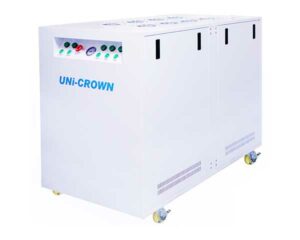 Quiet Air Compressor
Q-Air750D Quiet Air Compressor
Max Pressure 8kgf/cm2
775LPM @0kgf/cm2
Tank: 150L -